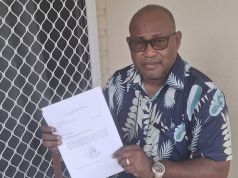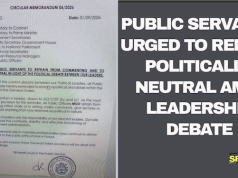


The Minister for Justice and Legal Affairs has resigned from Cabinet, citing concerns over the lack of consultation on major decisions affecting the justice sector, particularly the appointment and remuneration of the Attorney-General.
In a statement explaining the resignation, the Minister said they could no longer continue serving in Cabinet where decisions directly affecting the justice sector were being made without consultation with the Minister responsible for the sector.
The immediate concern centres on the appointment of the Attorney-General and the determination of the office holder’s remuneration and terms and conditions of service, reportedly amounting to approximately SBD$35,000 per fortnight.

The Minister stressed that the resignation was not a personal objection to the Attorney-General, saying the position was an important constitutional office and that the office and its responsibilities were fully respected.
Instead, the Minister said the concern was about the process, fairness and equity across the wider justice sector.
“As Minister responsible for Justice and Legal Affairs, I should have been consulted before a decision of this nature was made,” the Minister said.
SALARY SUPPORT FOR KEY LEGAL POSITIONS
The Minister said their only recent involvement in remuneration discussions had been a request to AUSAID for salary top-ups for two key positions within the Ministry — the Solicitor-General and Senior Legal Draftsman.
The request was made amid concerns over the Government’s loss of several legal cases and the need to attract and retain competent legal professionals in critical positions.
According to the Minister, AUSAID responded positively to the request.
However, the Minister said other decisions directly affecting the justice sector continued to be made without consulting the Minister responsible for the sector.
The Minister argued that the Attorney-General, as the Government’s principal legal adviser, holds an office whose terms and conditions have significant implications for both the justice sector and Government as a whole.
CALL FOR WIDER JUSTICE SECTOR REVIEW
The Minister said the Attorney-General was not the only senior constitutional office holder within the justice system.
The Director of Public Prosecutions and Public Solicitor, along with judges, magistrates, government lawyers and other legal professionals, all play critical roles in upholding the rule of law and administering justice.
The Minister said many government lawyers had for some time been seeking improvements to their employment terms and conditions, but there had not been a corresponding comprehensive improvement across the justice sector.
“It is therefore difficult for me, as Minister responsible for Justice and Legal Affairs, to justify a situation where the remuneration and terms and conditions of one constitutional office holder are substantially improved while the circumstances of other constitutional office holders, judges, magistrates and government lawyers remain essentially unchanged,” the Minister said.
The Minister stressed that the issue was not about denying anyone a fair salary, but about fairness, equity and consistency.
“If the Government has determined that the responsibilities and demands of the Attorney-General’s office warrant a significant improvement in remuneration, then we should also have a serious and structured discussion about the remuneration and conditions of the other key offices and professionals who sustain our justice system,” the Minister said.
‘JUSTICE SYSTEM CANNOT LEAVE OTHERS BEHIND’
The Minister called for judges and magistrates to be properly supported, while also seeking appropriate conditions for the Director of Public Prosecutions, Public Solicitor and government lawyers.
The statement warned that the justice system could not be strengthened by improving the conditions of only one office while leaving other key personnel behind.
The Minister also raised what was described as an important constitutional principle, arguing that decisions concerning constitutional offices should be handled carefully, transparently and through proper consultation.
“The Minister responsible for the sector should not learn of or be presented with major decisions affecting the justice system after those decisions have effectively already been made,” the statement said.
The resignation also raises questions about Cabinet government, collective responsibility and the role of individual Ministers in decisions affecting their respective portfolios.
The Minister said they could not in good conscience continue serving as Justice Minister while being expected to defend or support an approach considered unfair to the wider justice sector and made without proper consultation.
‘A MATTER OF PRINCIPLE, NOT PERSONALITY’
The Minister described the resignation as a matter of principle and responsibility rather than personality.
The Minister reaffirmed a commitment to the independence of the judiciary, the rule of law, equality before the law and a properly resourced justice system.
“Every person working to uphold justice and the Constitution deserves to be treated fairly,” the Minister said, calling for remuneration and employment conditions to be considered through a transparent, consistent and equitable process.
“The justice sector belongs to all of us. Its integrity must not be compromised by selective treatment or decisions made without proper consultation,” the Minister said.
AG HITS BACK SAYING ALLEGATIONS FALSE AND MISLEADING
But in response, Attorney General Suri said ttorney General Suri rejects allegations as “false and misleading”
Honiara, 2 September 2026 – Attorney General Gabriel Suri has rejected allegations made by former Justice Minister Clezy Rore, calling them false and misleading.
Speaking today, Mr Suri said the issues were never raised with him directly during his appointment.
“I would have addressed this immediately if the former Minister had raised it officially with me,” Mr Suri said. “Instead, I was welcomed into the role and even hosted a welcome party by the former Minister.”
He said raising the matter now, rather than at the time, undermines the credibility of the claims.
Mr Suri also addressed questions on remuneration.
He explained that externally recruited Solicitors General and Legal Drafters are paid at higher rates.
Because of this, he believes the Attorney General’s salary should serve as a benchmark when government reviews pay for the Director of Public Prosecutions, Public Solicitor, judges and magistrates.
“The responsibility to review and adjust those salaries lies with Government, not with me personally,” he said.
Mr Suri clarified the difference between a permanent career Attorney General and a contracted Attorney General. Only a contracted Attorney General has the right to negotiate remuneration.
He confirmed his own contract was negotiated with the Secretary to Cabinet [STC] and Deputy Secretary to Cabinet [DSTC], with the STC signing on behalf of Government.
Mr Suri said the shift to a contracted Attorney General model began when former Prime Minister Manasseh Sogavare dismissed then-Attorney General Primo Afeau and appointed Julian Moti.
“That decision fundamentally changed the structure of the office,” he said.
“I stand by the terms of my contract. It was negotiated in good faith and accepted by Government.”