
Sponsored Advertisement

𝗠𝘆 𝗢𝗯𝘀𝗲𝗿𝘃𝗮𝘁𝗶𝗼𝗻𝘀 𝗼𝗳 𝘁𝗵𝗲 𝗘𝗻𝘃𝗶𝗿𝗼𝗻𝗺𝗲𝗻𝘁𝗮𝗹 𝗮𝗻𝗱 𝗦𝗼𝗰𝗶𝗮𝗹 𝗜𝗺𝗽𝗮𝗰𝘁𝘀 𝗼𝗳 𝗡𝗶𝗰𝗸𝗲𝗹 𝗠𝗶𝗻𝗶𝗻𝗴 𝗮𝘁 𝗛𝗮𝘃𝗶𝗵𝘂𝗮 𝗩𝗶𝗹𝗹𝗮𝗴𝗲, 𝗪𝗲𝘀𝘁 𝗕𝘂𝗴𝗼𝘁𝘂 𝗜𝘀𝗮𝗯𝗲𝗹 𝗣𝗿𝗼𝘃𝗶𝗻𝗰𝗲
𝐁𝐲 𝐀𝐥𝐥𝐚𝐧 𝐒𝐞𝐫𝐮 𝐌𝐚𝐩𝐮𝐫𝐮, 𝐚 𝐌𝐚𝐬𝐭𝐞𝐫𝐬 𝐂𝐚𝐧𝐝𝐢𝐝𝐚𝐭𝐞 𝐚𝐭 𝐭𝐡𝐞 𝐔𝐧𝐢𝐯𝐞𝐫𝐬𝐢𝐭𝐲 𝐨𝐟 𝐭𝐡𝐞 𝐒𝐨𝐮𝐭𝐡 𝐏𝐚𝐜𝐢𝐟𝐢𝐜, 𝐋𝐚𝐮𝐜𝐚𝐥𝐚 𝐜𝐚𝐦𝐩𝐮𝐬, 𝐅𝐢𝐣𝐢 𝐈𝐬𝐥𝐚𝐧𝐝𝐬.
𝑰𝒏𝒇𝒐𝒓𝒎𝒂𝒕𝒊𝒐𝒏 𝒑𝒓𝒐𝒗𝒊𝒅𝒆𝒅 𝒉𝒆𝒓𝒆𝒊𝒏 𝒂𝒓𝒆 𝒃𝒂𝒔𝒆𝒅 𝒐𝒏 𝒕𝒉𝒆 𝒊𝒏𝒅𝒆𝒑𝒆𝒏𝒅𝒆𝒏𝒕 𝒐𝒃𝒔𝒆𝒓𝒗𝒂𝒕𝒊𝒐𝒏𝒔 𝒐𝒇 𝒕𝒉𝒆 𝒂𝒖𝒕𝒉𝒐𝒓
During my assessment through ethnographic observation of the mining activities at Havihua, I became increasingly concerned about the environmental and social impacts of the development. As I examined the Environmental Impact Assessment (EIA) and considered the experiences of the local villagers, I observed several areas where environmental protection, climate change, disaster risk reduction, public consultation, community livelihoods and worker welfare appeared to receive inadequate attention. In my view, the situation at Havihua demonstrates that an EIA should not simply be a document prepared to allow a development to proceed. It should provide a practical framework for protecting the environment, respecting local communities and reducing the risks associated with development.
One of my major concerns was the limited consideration of climate change and disaster risk reduction in the EIA. I believe these two areas are important because mining activities can increase environmental risks, while climate change can make existing hazards such as heavy rainfall, flooding, erosion and storms more severe. Disaster risk reduction is important because it helps identify potential hazards before they cause serious damage and allows appropriate measures to be put in place to protect people, infrastructure and the environment. Climate change is equally important because environmental management needs to consider how changing weather and climatic conditions may affect the mining operation and surrounding ecosystems over both the short and long term.
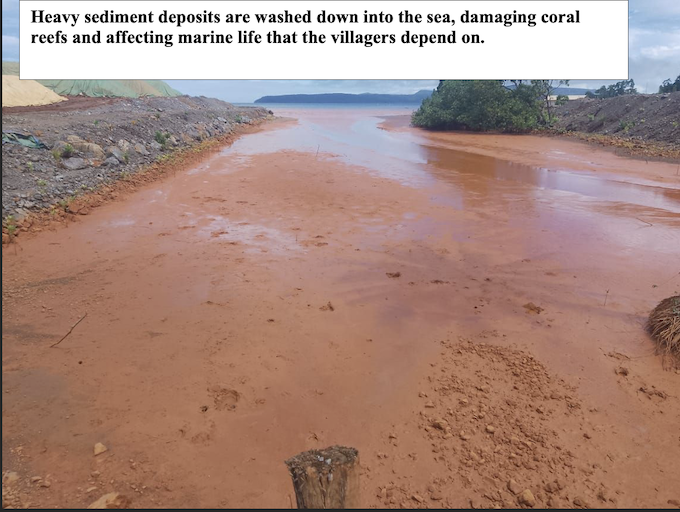
The importance of climate change and disaster risk reduction became particularly clear to me during periods of heavy rainfall. Heavy rainfall can increase runoff from disturbed mining areas and carry large amounts of sediment into nearby aquatic and marine environments. I observed that the measures used to contain sediment were not always properly maintained. In particular, the canvas or sediment-control material was reportedly left open or rolled up even during periods of heavy rainfall. From my observation, this reduced its effectiveness in preventing sediment from leaving the mining area. This situation concerned me because poorly controlled sediment can enter marine environments and affect coral reefs and other organisms.
I was particularly concerned about the effects of sedimentation on marine life. The surrounding marine environment is important to local communities because it provides food, supports livelihoods and forms part of the natural environment on which villagers depend. Heavy sedimentation can reduce water clarity and place stress on coral reefs and other marine organisms. I was therefore concerned that the impacts of mining were not limited to the immediate mining area but could extend into the wider marine environment. Despite these concerns, I found no clear evidence of adequate compensation or meaningful marine rehabilitation for the impacts experienced by the affected environment and communities.
Another issue that concerned me was the apparent lack of marine rehabilitation. I found little evidence of meaningful measures such as coral planting or coral rehabilitation to address damage to marine ecosystems. For me, this raises an important question about what happens to the marine environment after mining activities have affected it. Simply stopping an activity does not necessarily restore an ecosystem. Where marine ecosystems have been damaged, rehabilitation should be properly planned, implemented and monitored.
I was also concerned about the damage to mangrove areas. Mangroves are important because they provide habitat for wildlife, support food chains, protect coastal areas and contribute to the livelihoods and food security of coastal communities. From what I observed, mangroves affected by the mining activities did not appear to receive adequate rehabilitation. I believe that damage to mangroves should have been properly assessed and followed by a clear restoration programme. The importance of mangroves should not be overlooked simply because they may not be located directly within the main mining area.
Waste management was another issue that caught my attention. I observed rubbish being disposed of carelessly around the mining site and concerns about the absence of a properly managed disposal area. Poor waste management can create environmental and public health risks, especially when waste is located near drainage systems, soil, surface water or marine environments. I believe the mining operation should have had clear procedures for waste collection, storage, treatment and final disposal. These procedures should also have been monitored to ensure that they were actually being followed.
I was also concerned about the potential risk of heavy metals and other contaminants entering the surrounding aquatic and marine environment. From my assessment, there appeared to be insufficient evidence of regular testing to determine whether potentially harmful substances were entering nearby water bodies. Without appropriate water-quality and contamination monitoring, it becomes difficult to determine whether the surrounding water remains safe or whether contamination is occurring. This is particularly important because local people depend on their surrounding marine and coastal environment for food and other daily needs. In my view, regular environmental testing should have been part of the mining operation, with the results communicated transparently to the affected communities.
Another major concern for me was the lack of meaningful consultation with local villagers before certain activities proceeded. I believe consultation is an important part of the EIA process because local communities possess knowledge about their environment, fishing areas, natural resources and culturally important places that may not be fully identified through technical assessments alone. Before decisions are made that affect people’s livelihoods and access to resources, villagers should have a genuine opportunity to understand what is proposed, raise concerns and participate in decisions that affect them.
The change in fishing grounds particularly affected me. As mining activities changed access to or conditions around some fishing areas, villagers were reportedly forced to move toward more isolated and difficult locations to continue fishing. Some of these areas are perceived by villagers as places where crocodile attacks may occur and where there are also traditional beliefs about mystical or spiritually significant presences. Whether these beliefs are interpreted culturally, traditionally or otherwise, they form part of how some villagers understand and experience their environment. What concerned me most was that people felt they had little choice because fishing remained necessary for putting food on the table. This shows how an environmental impact can also become a livelihood and safety issue. When people’s traditional fishing grounds are affected, alternative access and livelihood arrangements should be considered rather than leaving villagers to bear the consequences themselves.
I was also concerned about the removal of trees and timber from the current mining site. From what I observed and was informed, trees and timber were cut down as part of the mining activities, yet the villagers had concerns that they had not been adequately compensated for the timber that was removed. This issue is important because trees and timber can have both economic and practical value to local communities. If resources belonging to or traditionally used by villagers are removed through development activities, there should be a clear and transparent process for determining ownership, valuation and compensation. The absence of clear information about these matters can create mistrust between the company and the community.
The issue of transparency appeared to extend beyond environmental matters. I became concerned that some dealings between the mining company and affected people were vague, making it difficult for villagers and workers to understand how decisions were being made and how certain payments or compensation were determined. I also understood that payments associated with shipments of ore were sometimes delayed, while there were concerns about transparency regarding workers’ payments. For me, transparency is important because workers and communities should be able to understand the arrangements that directly affect their livelihoods. Clear records, communication and accountability can help reduce uncertainty and conflict.
My concerns were not limited to the surrounding environment and community. I also became concerned about conditions within the mining camp. Poor sanitation can create risks to worker health and wellbeing, particularly when hygiene facilities, food preparation and waste management are inadequate. I was also concerned about the quality and healthiness of food provided to workers. These conditions are relevant to the wider social impacts of mining because environmental management should also consider the people who work within the project and the conditions in which they live.
The terrestrial rehabilitation measures also raised concerns for me. Although rehabilitation appeared to form part of the mining process, I found the proposed measures to be vague and difficult to assess in terms of their actual effectiveness. In my view, rehabilitation should not simply involve covering disturbed areas or planting trees without clear objectives and monitoring. A proper rehabilitation programme should identify what the land is expected to look like after mining, what ecological functions should be restored, who is responsible for the rehabilitation and how its success will be measured. Without these elements, rehabilitation can become a promise on paper rather than an effective environmental management measure.
Overall, my assessment of the Havihua mining activities left me concerned about the gap between environmental assessment and actual environmental management. The issues I identified include inadequate consideration of climate change and disaster risk reduction, heavy sedimentation, impacts on coral reefs and marine life, damage to mangroves, poor waste management, inadequate environmental monitoring, weak terrestrial rehabilitation, limited marine rehabilitation, insufficient consultation with local communities, changes to fishing grounds, concerns about safety, removal of timber without clear compensation, and a lack of transparency in some dealings with workers and villagers.
As I reflect on what I observed, I believe the Havihua experience demonstrates why environmental management must consider the whole community and ecosystem rather than focusing only on the extraction of mineral resources. A development can create economic opportunities, but those opportunities should not come at the expense of the environment, community livelihoods, cultural values or people’s safety. Meaningful consultation should take place before activities that significantly affect local resources are undertaken. Environmental monitoring should be continuous, mitigation measures should actually work in practice, and rehabilitation should be measurable and properly implemented.
For me, the most important lesson from Havihua is that an EIA should continue to have value after the report has been approved. It should guide what happens during mining operations and provide accountability when mitigation measures fail. Climate change and disaster risk reduction should be integrated into planning because they can increase existing environmental risks. Marine ecosystems and mangroves should be protected because they support biodiversity, food chains and community livelihoods. Local villagers should be meaningfully consulted because they are directly affected and possess valuable knowledge of their environment. Finally, compensation, worker payments and other dealings should be transparent so that affected people understand how decisions are made and how their interests are being addressed. In my view, these elements are essential for ensuring that environmental management at Havihua is practical, accountable and responsive to the people and environment affected by mining.
Disclaimer: The views expressed in the article are of the author and in no way represent SBM.
What you think?
Sponsored Advertisement