
Sponsored Advertisement

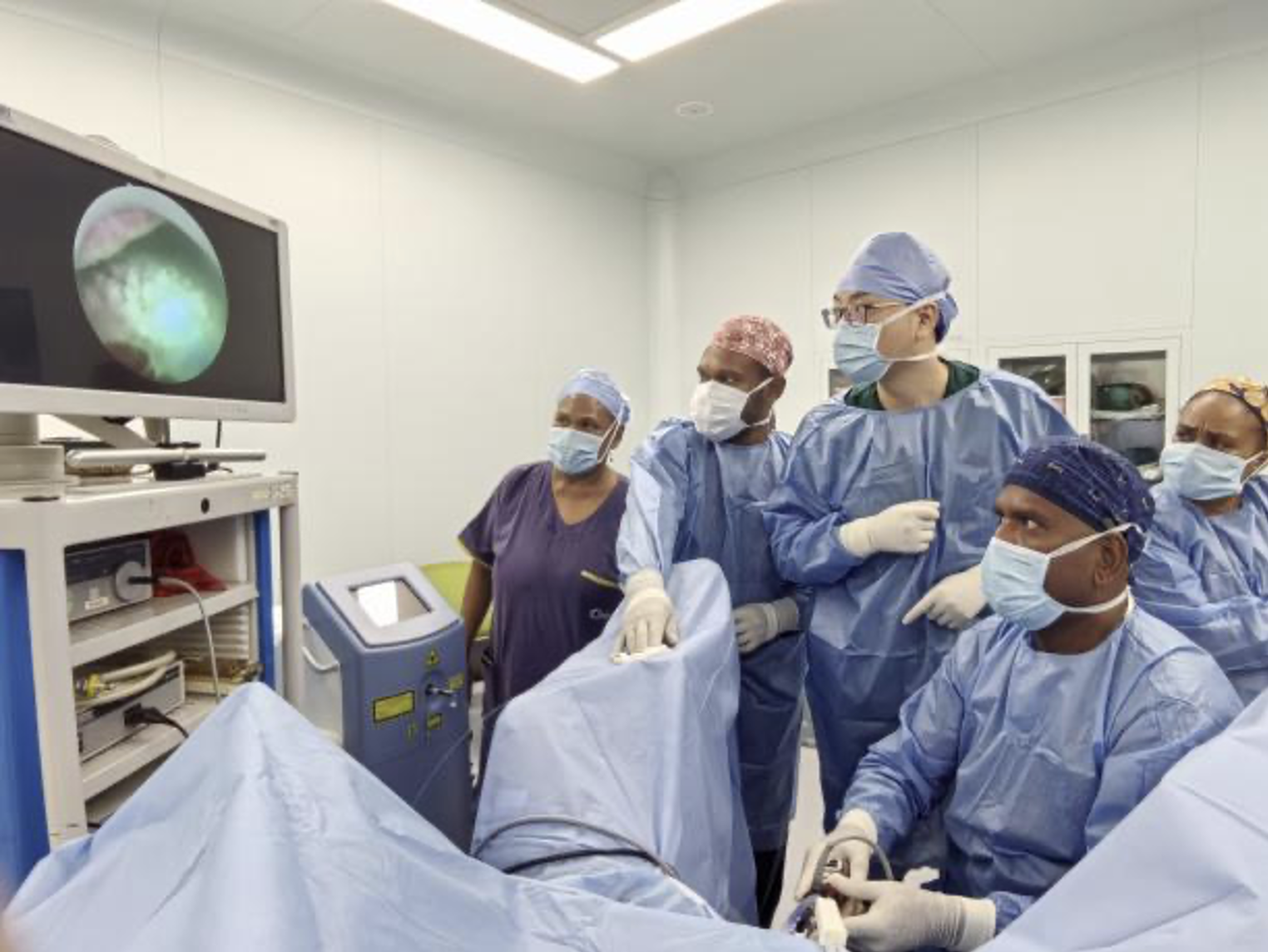
In a major medical breakthrough, the China-aided National Referral Hospital Comprehensive Medical Center (CMC) has successfully performed the country’s first holmium laser lithotripsy for bladder stones, marking Solomon Islands’ formal entry into a new era of minimally invasive urological surgery.
The historic procedure was carried out jointly by Dr. Augustine Melly, a local surgeon, and Dr. Chen Xulong of the 4th China Medical Team.
Bladder stones are a common health issue in Solomon Islands, affecting not only adult men but also women and children. In the past, patients had to undergo open surgery, which involved large incisions, longer recovery periods, and higher risks of complications — often resulting in considerable pain and financial burden.
Holmium laser lithotripsy, the global standard for treating urinary stones, allows doctors to fragment and remove stones without opening the bladder. The procedure offers significant advantages such as minimal trauma, reduced bleeding, faster recovery, and lower infection risk.
Thanks to deepening China–Solomon Islands medical cooperation, the holmium laser technology was introduced to the country under the “China–Solomon Islands Urological Minimally Invasive Surgery Center Project.” The project provided both the equipment — including the laser device and fibers — and the necessary technical training.
During the procedure, Dr. Melly led the operation while Dr. Chen provided technical guidance and shared expertise. The collaborative effort demonstrated close coordination in equipment setup, energy adjustment, and lithotripsy techniques.
Dr. Melly and Nurse Densy, both part of the surgery team, had earlier completed a three-month training program at the Affiliated Hospital of Guizhou Medical University in China, where they studied and practiced various minimally invasive urological procedures. Their successful application of the technique upon returning home highlights the tangible outcomes of the “technical support – talent cultivation – results transformation” model of cooperation between the two nations.
Following the operation, the patient was transferred to the newly opened Urology Ward at the CMC for recovery. The patient is reported to be in good condition and recovering well in the ward’s modern, comfortable facilities.
According to Zhao Xueke, leader of the 4th China Medical Team, the successful completion of this surgery demonstrates ongoing efforts in technical assistance, capacity building, and equipment support. Zhao said the achievement also underscores the growing friendship and medical partnership between China and Solomon Islands.
Looking ahead, the China Medical Team plans to expand the use of holmium laser technology to treat kidney stones, ureteral stones, and prostatic hyperplasia, helping Solomon Islands’ urology services reach new heights and making advanced medical care more accessible to local patients.
Meanwhile, the Comprehensive Medical Center at the National Referral Hospital is now fully operational, offering specialist surgeries, inpatient care, and advanced treatment services, allowing Solomon Islanders to receive modern, high-quality healthcare close to home.
End.
What you think?
Sponsored Advertisement