
Sponsored Advertisement

By: Martin B. Housanau
Introduction:
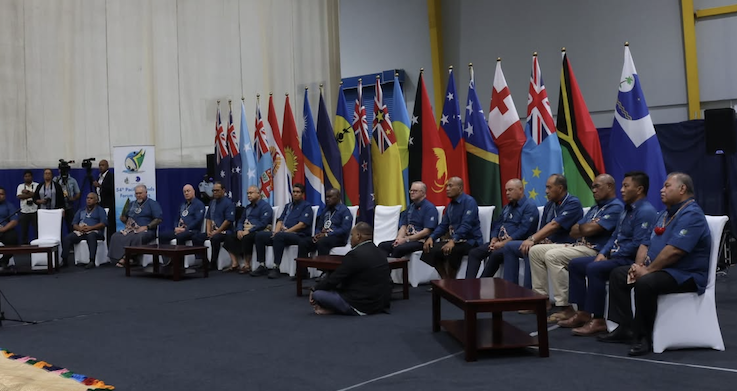
Honiara has just borne witness to a milestone in Pacific regionalism – the 54th PIF has concluded by the end of last week, leaving behind not just bold declarations but a renewed spirit of unity and resolve. Against a backdrop of intensifying climate threats, geopolitical shifts, and growing economic challenges. This week’s gathering stood out for its powerful message “Iumi Tugeda: Act Now for an Integrated Blue Pacific Continent”.
Leaders of the Pacific convened, not for ceremonial handshakes, but for concrete commitments – reasserting that the region will chart its own course, on its own terms. The exclusion of dialogue partners this year sharpened the focus inward – to home grown priorities, Pacific values and collective action.
But how sure are our Pacific Leaders in maintaining our focus and collective action in the foreseeable future? As the Forum closed its doors in Honiara, the echo of this gathering reverberates across our Islands. The challenge now is simple yet profound; to transform words into action – for our oceans, our cultures, and our generations to yet to come.
The Spirit of the PIF:
The Pacific is not just a vast ocean; it is home to a deeply connected family of Island Nations bound by culture, history, and shared challenges. As the world’s attention increasingly turns towards our region – for its resources, strategic value and climate leadership – it has never been more important for Pacific peoples to speak with one voice. The PIF was created to be that voice; a platform for regional cooperation, solidarity, and self-determination.
Yet as external interests seek a greater role in Pacific affairs, the integrity of the Forum must be protected. The time has come to reaffirm that the PIF exists first and foremost for Pacific peoples, by Pacific peoples. To truly serve our interests, protect our sovereignty, and uphold our shared values, the Forum must remain a space exclusively for Pacific Island Countries (PIC’s) – guided by those who live the Pacific reality every day.
The PIF should maintain only the PIC’s as Members:
The ideal reasons to maintain only PICs in the PIF—excluding external or non-Pacific Island members like Australia and New Zealand—then the PIF becomes more regionally pure, self-determined, and maintains its sovereignty. The critical reasons to maintain only the PIC’s in the PIF are immense as highlighted below.
-
Pacific Self-Determination and Sovereignty
-
Equal Voice and Political Balance
-
Shared Cultural and Historical Identity
-
Independent Foreign Policy and Global Advocacy
-
Focused Climate and Development Goals
-
Reclaiming the “Pacific Way”
-
Strengthening Intra-Pacific Solidarity
-
Recalibrating Regional Architecture
-
Pacific Self-Determination and Sovereignty
Regional Autonomy: Keeping the Forum exclusively for PICs reinforces the right of Pacific nations to set their own priorities without external influence.
Decolonization Goals: Some Forum members (e.g., New Caledonia, French Polynesia) are still non-self-governing. A PIC-only Forum can better support decolonization without conflict of interest from colonial powers or their allies.
-
Equal Voice and Political Balance
Avoiding Power Imbalances: Australia and New Zealand have more resources, larger populations, and greater diplomatic weight, which can skew decision-making.
Strengthening Equal Representation: A PIC-only Forum ensures that all members have equal influence, fostering genuine Pacific consensus and collaboration.
-
Shared Cultural and Historical Identity
Common Values: PICs share unique traditions, languages, and worldviews that differ significantly from settler-colonial nations like Australia and New Zealand.
Stronger Cultural Cohesion: Without external actors, the Forum can focus more deeply on Pacific-led solutions rooted in indigenous knowledge and shared regional values.
-
Independent Foreign Policy and Global Advocacy
Unified Pacific Diplomacy: A PIC-only Forum can more effectively coordinate diplomatic stances (e.g., on climate change, nuclear legacy issues) without interference from larger external interests.
Avoiding Strategic Co-option: With rising geopolitical tensions (e.g., U.S.–China competition), a PIC-only Forum avoids becoming a tool of larger powers’ strategic agendas.
-
Focused Climate and Development Goals
Tailored Environmental Solutions: Climate change impacts PICs differently than Australia and New Zealand. A PIC-only Forum allows for strategies specifically designed for small island states.
Development Aligned with Local Needs: Australia and New Zealand often drive donor priorities. A PIC-only forum would prioritize development led by local needs, not donor interests.
-
Reclaiming the “Pacific Way”
Reviving Traditional Governance Models: A PIC-only space can focus on governance approaches that reflect indigenous Pacific leadership, consensus-building, and community-based decision-making.
Reduced Bureaucratic Influence: Without larger bureaucracies shaping the agenda, Pacific nations can streamline processes and make decisions in a way that respects traditional values.
-
Strengthening Intra-Pacific Solidarity
Regional Cohesion: The shared experiences of vulnerability (geographic, economic, climate) mean that PICs understand each other better and can more effectively support each other.
Shared Development Challenges: A PIC-only Forum allows collaboration on uniquely Pacific issues—like remoteness, sea-level rise, and limited economic diversification—without external distraction.
-
Recalibrating Regional Architecture
Creating Space for New Relationships: Removing Australia and New Zealand could make room for new partnerships (e.g., with ASEAN, African island states, or non-aligned nations).
Clarifying Forum Purpose: It could re-define the Forum as a true Pacific Islander-led institution, distinct from donor-driven regional bodies.
The Post-Forum Dialogue (PFD) is Irrelevant for PIC’s:
The PFD has long been part of the PIF process, allowing external partners – such as the US, China, Japan, EU, UK, and others to engage with the Forum leaders after the internal meetings. However, there is growing concern especially among the PIC’s that the PFD has become increasing irrelevant, and even counterproductive to the Forums core mission because of undermining Pacific sovereignty and unity, distracts from regional priorities, reinforces the donor-recipient power dynamic, dialogue partners already have other engagement channels, prevents the forum from turning inward.
The PFD is a relic of the past at a time when the Pacific felt it needed outside validation. Today, PIC’s are stronger, more united, and more capable of setting their own course. If the Forum is to be true expression of Pacific regionalism, then it must be unapologetically Pacific, free from the shadow of external interests.
Australia and New Zealand must Leave the PIF:
These two countries continued full membership in the PIF compromises the integrity, independence and unity of the Pacific region. The time has now come to transition Australia and New Zealand out of the Forum just to become partners and not member due to they are not PIC’s, they skew the balance of power, conflicting interests – especially on climate change, they are aligned with Western Military and Security agenda, their influence hinders honest regional conversations, and they are donors and not members.
Foremost, the economies of the PIC’s have achieved unsustainable growth over the past five decades, rather becoming more dependent on Australia and New Zealand now than before. However, it is critical to uphold the Forum’s true purpose as a platform for Pacific-led solutions to Pacific led challenges. Thus, PIF must exclude Australian and New Zealand from the Forum to enhance the PIC’s growth and stability.
In Summary:
The ideal reasons to maintain only Pacific Island Countries in the Forum center on:
-
Sovereignty and self-determination
-
Industrialization and wealth creation
-
Economic growth and prosperity
-
Equity and cultural identity
-
Unified climate advocacy
-
Freedom from external political or economic agendas
Australia and New Zealand are friends of the Pacific – but they are not Pacific Island Countries. For the PIF to remain relevant, powerful and truly representative, it must be led exclusively by those who live the Pacific reality every day. It’s time to reclaim the Forum for the Pacific, by the Pacific.
(Disclaimer: The views and opinions expressed in this article are those of the author and do not necessary reflect the official policy or position of any affiliated organization, publication, or entity. The information provided is for general informational purposes only. The content may contain references to sensitive topics. Thus, readers are advised to use discretion from the use of this content. The Author is not liable for any interpretations or consequences resulting from the use of this content)
What you think?
Sponsored Advertisement